


Stephen Siderow, the former president and co-founder of BlueMountain Capital Management, the once high-flying, multibillion-dollar hedge fund that became renowned for a huge winning bet related to JPMorgan Chase’s London Whale, has good investment problems.
Even as BlueMountain’s performance faltered during the 2010s, the firm made money, and Siderow was a beneficiary. While still heavily invested in his company’s funds, he also had capital to invest in the broader stock market and private investments to diversify his portfolio. After BlueMountain sold to an insurer and Siderow parted ways with the hedge fund, he had more cash, ramped up his investments in private equity and private credit funds, and made dozens of co-investments alongside the managers.

While he was happy with the performance of his investments, the hedge-fund founder was also feeling less sure of the risk he was taking. During quarterly meetings, his private bankers presented reports that sometimes felt stale and left him wanting more.
“Over time, you start to amass more and more of these things…private investments that were harder to manage,” Siderow told Modus.
“I wanted to see it — as, if you will, a financial professional, a hedge-fund person — in what I thought was a logical way, the way I thought about risk. And that's not how this stuff is set up. It's set up by your equity investments, mutual funds, and this and that. It's not really organized by risk, especially as you start to add private [investments],” he said.
Siderow knew much of his personal balance sheet was being compiled from disparate systems and aggregated manually, which was tedious and prone to error. Choosing his own categorization or labels for certain asset classes and investments was a pain or impossible. “Alternative investments” was a term without meaning. “Private credit is not venture,” Siderow said. “So why is that in the same bucket?”
Siderow began using Arch, the software platform for private investments that raised a $52 million Series B round of funding last fall. While helpful, it didn’t paint the total investment picture he desired.
A former colleague recently presented a solution that Siderow is energized about.
Michael Liberman, the former co-president and managing partner at BlueMountain, had similar frustrations to Siderow. He had become wealthy, but managing his own investments was nothing like what he was accustomed to. After leaving the hedge fund, he leveraged his experience building its portfolio construction, risk management, and analytics software and created a personal system for himself.
“There was kind of a gap in the technology. There were expensive, relatively hard-to-operate, family-office-type tools that often required teams to operate them. And then there were personal finance apps that were often pretty slick and user-friendly, but that couldn't handle the complexity of both the family structure and all the different entities and trusts and companies,” Liberman said.
With his own platform, Liberman consolidated information from various brokerage accounts with investments in stocks and funds, as well as bank and savings accounts, credit cards and more (all of which are commonplace among cheap and even free apps today). In addition, he established connections with Arch and Carta, an equity and fund management company, and is working on direct connectivity with private investment companies to gain better, more immediate access to details about their funds and portfolio companies. The platform also allowed him to categorize line items as he saw fit, to better understand where money was coming in and going out.
Liberman told friends about it, who asked if they could use it, too. He was happy to share it, and it wouldn’t take more than a couple of hours to set up, he explained.
“He told me that it would do all this stuff and I'd be able to just check in anytime and see it live on my phone or on my laptop. That sounded too good to be true,” said Siderow, who became a user after seeing the platform in action.
Believing there was a commercial opportunity, Liberman named the software Allposit and raised capital from users and angel investors, including Siderow. The startup did not disclose how much money it raised. Five months ago, it hired its first employee, Zac Gelfand, who is its chief revenue officer. Prior to joining, Gelfand was a client experience manager at Arch.
Since then, the company says it has routinely added users, including single-family offices. The software costs $7,500 per year.
“I think there are a lot of people who want a digital way to see their balance sheet, and it's hard to find something that is cost-effective, nimble, and holistic. I feel like they've kind of nailed that. It seems like a really pragmatically priced solution that is flexible, tech-forward, and works well with other platforms. And that people seem to think fits that ultra-high-net-worth type of use case very, very well,” said Ryan Eisenman, co-founder and CEO at Arch, which shares clients with Allposit. Eisenman is not an investor in Allposit.
To be sure, Allposit is far from the first software to aggregate financial information into one place. Companies like Black Diamond Wealth Solutions (owned by SS&C), Addepar and others have been around for many years. Like Liberman, others have also identified a gap between powerful, costly software used by family offices and personal finance apps. MyFO, a Vancouver, Canada-based startup that is similar to Allposit, raised $3.5 million in seed funding in 2024.
In addition to his own experience using the platform, Siderow is encouraged by the other users and backers, including Andrew Feldstein, the co-founder and CIO at BlueMountain. At the hedge fund, Siderow said that Feldstein was “incredibly demanding” of Liberman and others who built the robust systems that made the asset manager successful.
“If he was behind it and a user, that's probably a good indication that it was highly robust,” Siderow said.
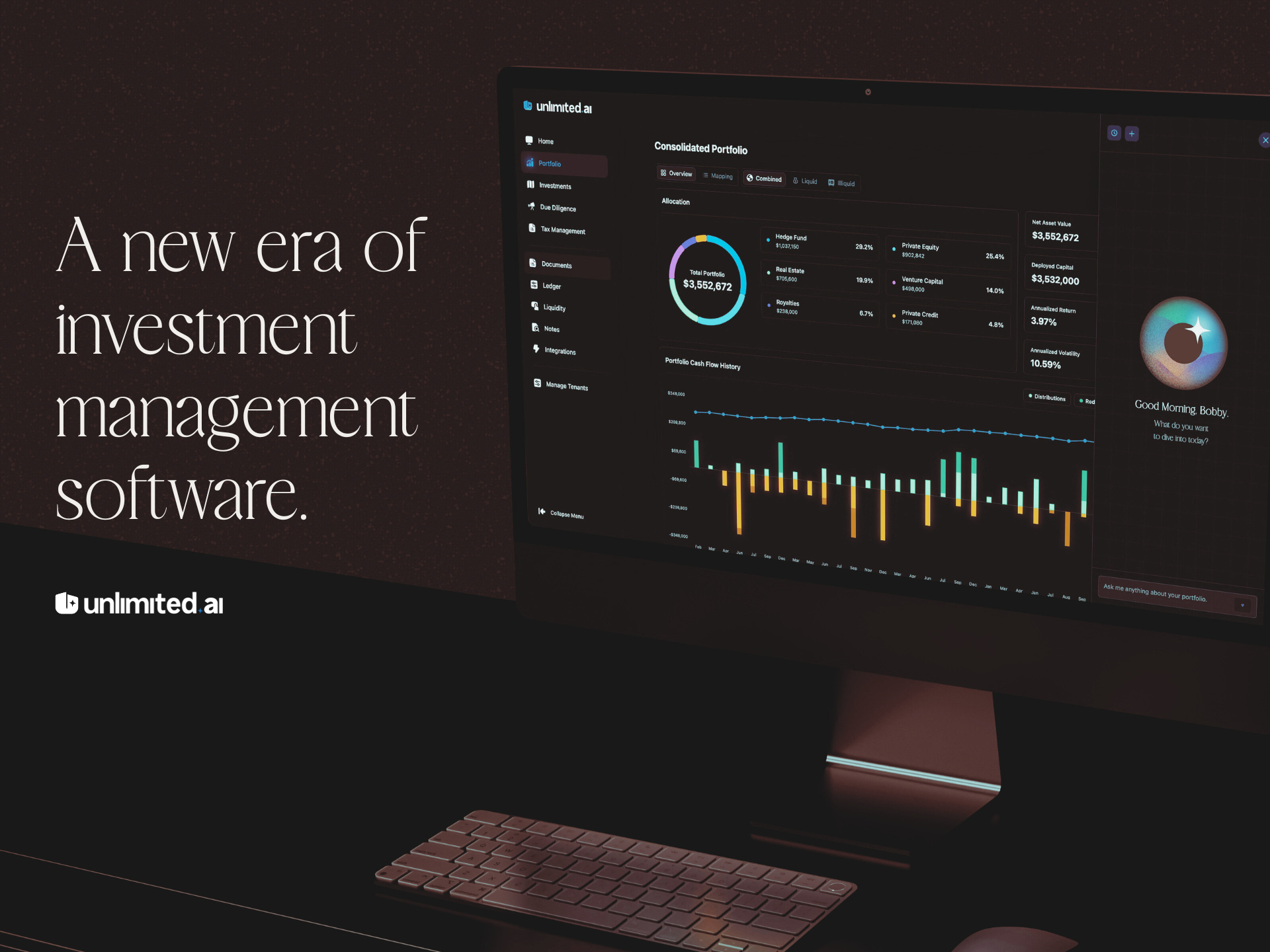
The private markets are driven by context that never gets captured.
The complex reasoning behind critical decisions—why you sized that position differently, what made those terms acceptable, why one team was preferable to another—fades into the inbox abyss once an investment is made. And in an era of increasing talent mobility, institutional knowledge has become institutional risk.
Patchworks of single-point solutions that don’t communicate context produce risks you no longer have to tolerate.
LAILA, our expert private markets agent, is purpose-built for family offices and RIAs to capture this context in one system, giving your team a digital system of intelligence for the first time.
This is the future of the private markets. Where orchestration forms context, and context compounds into alpha.
Head over to Unlimited.ai or reach out to see LAILA in action by clicking the link below.
More News
- From Modus last week: Family Office Access, a Database With Thousands of Professionals, Sells to ISS Market Intelligence.
- In January, Modus predicted there would be more family-office journalism in 2026, and that’s already happening...
The Information recently hired reporter Eli Rosenberg to cover artificial intelligence and its tie-ups with culture and wealth in San Francisco and beyond. He’s worked at The Washington Post, The New York Times, and other places, and he's a nice guy. Send him a note if you’re in the Bay Area: eli.rosenberg@theinformation.com.
And, after eight years covering private equity, Wall Street Journal reporter Miriam Gottfried is switching beats to report on individual investing and the wealth management industry. If you’re wondering whether that means family offices, she already dug into the Epstein files and pieced together much of former Apollo Global Management CEO Leon Black’s personal ledger from years ago. Send Miriam ideas and tips: miriam.gottfried@wsj.com. - CIO Group, the wealth management firm founded by David Bailin, the former global head and chief investment officer of Citi’s wealth division, released its own proprietary artificial intelligence tool early this week. COLOR AI, the firm says, can guide asset allocation, identify tactical opportunities, support cash management, and make sure portfolios are tax-efficient.
COLOR AI is part of a wave of powerful AI tools launching within software and platforms that is starting to break.
On Tuesday, Altruist, a venture-backed custodian with native investment management tools for advisors, launched an AI tax planning tool called Hazel that appeared to sink the shares of Raymond James Financial, Charles Schwab and LPL Financial (all of those companies custody assets for wealth managers, in addition to their other business lines).
Related: In 2019, I wrote what I think was the first news story about Altruist and the startup’s goal of challenging Schwab, TD Ameritrade (which Schwab later acquired) and others. Some people emailed me at the time to say that it was bad journalism; that the article gave false credibility to a David who would never overcome those Goliaths. I hope those people read this newsletter. - Blackstone Founder Steve Schwarzman Aims to Build a Top 10 Private Foundation.
- Bitcoin is still about $70,000 too high, Financial Times columnist Jemima Kelly argued this week.
- UBS published a Family Enterprise Governance report, which detailed the “practices that are most effective in driving outcomes across…the family, trustees, family office, investment program, business, philanthropy and family bank.” It surveyed 100+ offices, but, like all surveys by large banks, the respondent pool reflects their clients, with an average family net worth of $2.4 billion, some distance from that of the typical family office.
- Nasdaq Private Capital Indexes launched this week. The benchmarks are designed to help institutional investors and consultants — and maybe family offices? — benchmark performance and analyze their exposures.
- Co-Chief Executive Officers Doug Ostrover and Marc Lipschultz have pledged more than half of their Blue Owl stakes to secure loans from financial institutions. The stock has recently plunged, making investors nervous that their share sales to meet margin calls could drag the price even lower.
- McKinsey & Co. is handing over management of its $20 billion investment arm to Neuberger Berman. For decades, the McKinsey Investment Office, or MIO, managed the fortunes of its current and former partners by allocating to sophisticated hedge-fund and alternative strategies — and it did not like talking about it. In 2019, my former Institutional Investor magazine colleague Michelle Celarier wrote a story about MIO. The consultant tried so hard to squash the article that it ended up with the headline: The Story McKinsey Didn’t Want Written.
Jobs
- Featured role from Stryde Search: A prominent, international single-family office that supports ventures, investments, and philanthropy is hiring a senior human resources director in Connecticut. This person will report to the chief human resources officer and be both a strategic and operational leader to the family office. It’s three day in-office per week and attractive pay; $250,000 to $450,000 based on experience, plus comprehensive benefits. If you’re interested or know anyone who might be, reach out to Lisa Slagel at Stryde Search: ls@strydesearch.com.
- Cresst is hiring an associate director of family governance and education in Chicago.
- Arch is hiring a chief of staff for Ryan Eisenman in New York City.
- Mack International is running a search for a “fast-paced, growing” single-family in New York City with two first-generation principals who are hiring a chief financial officer. One is the founder of a software company who is also an avid investor in venture capital and private equity. The second principal founded the family’s private foundation and has maintained a global philanthropic presence throughout her adult life.

Other Stuff
- Follow Modus on LinkedIn.
- Don't forget to send me news tips. I’m especially interested in software companies and service providers that have family offices as customers. To share information in confidence, you can reply to this email or message me on Signal, using a personal device that your employer cannot access.
- Want to sponsor Modus? Fill out this form to see why half of 2026 is already sold out.
I'll be...
- Packin’ up in Prospect Heights. The reusable moving boxes have arrived, and we found renters (who I think are going to be amazing and maybe new friends), so we don’t have to keep up appearances. Please disregard the background chaos during my video calls.
- On my couch. (Please no Traitors spoilers tonight! My wife is traveling and we haven't watched yet.)
A correction made on February 13, 2026: A previous version of this newsletter incorrectly reported that Allposit had already established direct connections with private investment companies. It is currently working on those connections.


